Food handling facilities throughout Charleston, from riverfront restaurants near Haddad Riverfront Park to hospitality prep lines in the East End and Kanawha City, face persistent pressure from moisture-seeking pests.…
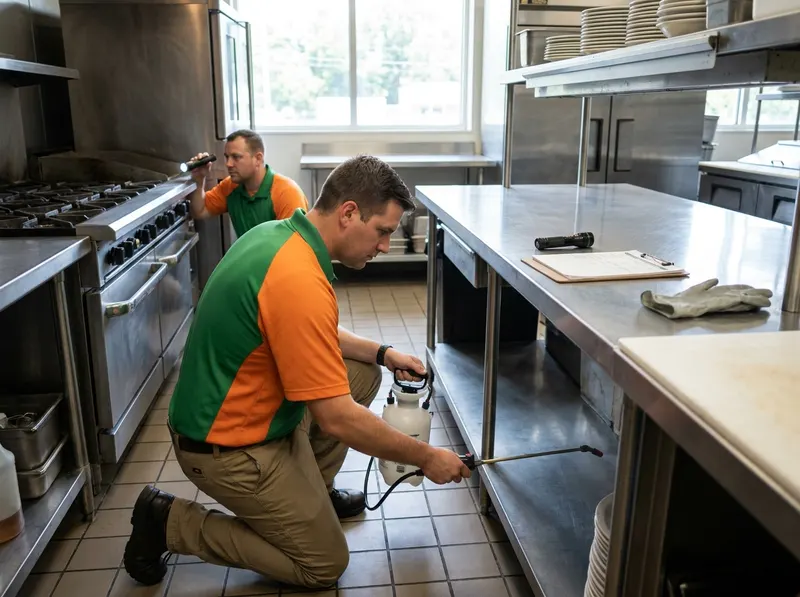
Food handling facilities throughout Charleston, from riverfront restaurants near Haddad Riverfront Park to hospitality prep lines in the East End and Kanawha City, face persistent pressure from moisture-seeking pests. High ambient humidity from the Kanawha River, combined with grease accumulation in sub-floor plumbing, creates optimal harborage for German cockroaches and drain flies. Standard surface wiping does not remediate organic biofilm trapped under low-clearance stainless preparation tables, commercial dish pits, and tiled grout lines. Professional commercial kitchen defense relies on deep-action enzymatic bioremediation that digests food-grade fats, oils, and grease inside grease traps and floor sinks, eliminating the exact micro-habitats where fly larvae mature and pests feed.
Effective kitchen hygiene requires physical structural exclusion rather than broadcast chemical spraying, which risks food contact surface contamination. Service technicians isolate and seal 0.25-inch conduit voids behind dishwashers, motor housings on walk-in coolers, and wall penetrations throughout prep lines using metal mesh and silicone caulking. Facilities located in historic footprints across the West Side or brick structures along MacCorkle Avenue often encounter pest migration along shared utility conduits and plumbing chasms. Sealing these entry corridors cuts off the moisture pathways that draw roaches and rodents out of municipal drainage into prep zones.
Operational decision-making depends on facility volume and pest pressure. Smaller cafe prep areas under 800 square feet fit single-session drain clearing and localized bait matrices; high-turnover dining facilities above 2,500 square feet near the Clay Center or Downtown require integrated line cleanouts combined with off-hours non-volatile bait applications. Unlike basic store-bought baseboard sprays, which scatter roach populations deeper into hollow stainless legs and wall voids, targeted insect growth regulators (IGRs) and non-repellent transfer compounds stop reproductive cycles at the root. The baseline investment begins at $200, with exact rates verified during an on-site structural audit. Operators can arrange an assessment by calling (681) 661-0137.
Every job gets a firm, written price after a free on-site visit.
Tell us about your commercial kitchen sanitation pest defense job in Charleston and we'll send a clear, written quote, usually the same day.
 Tavirox Pest Management