Crawl space encapsulation moisture control serves as a primary structural defense line in Kanawha County, where high ambient river humidity and Appalachian hillside runoff keep foundation dirt floors continuously…
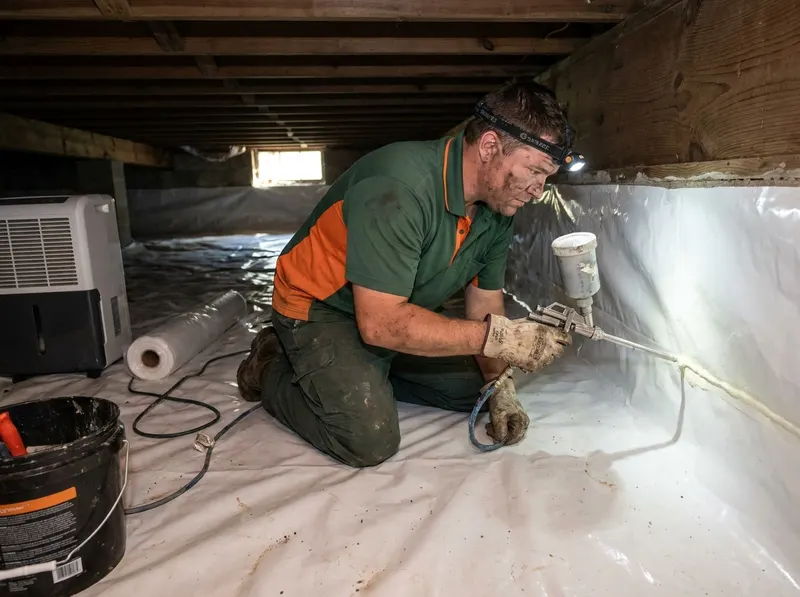
Crawl space encapsulation moisture control serves as a primary structural defense line in Kanawha County, where high ambient river humidity and Appalachian hillside runoff keep foundation dirt floors continuously saturated. Subterranean termites require continuous access to moisture above 70% relative humidity to build survival tubes, while wood-decaying fungi germinate on floor joists once wood moisture content reaches 19%. Sealing off open earth prevents ground moisture from evaporating directly into the subfloor structure, maintaining an environmental buffer that discourages subterranean pest colonies without relying solely on recurring chemical applications. For hillside foundations in South Hills, Fort Hill, and Loudon Heights, surface water often trickles along sloped foundation stem walls, creating pooling beneath the home. Meanwhile, older stone and concrete block foundations across the East End, Edgewood, and West Side frequently draw capillary moisture from shallow river valley water tables near the Kanawha River.
Selecting crawl space encapsulation moisture control over basic loose plastic sheeting depends on existing foundation conditions. Standard 6-mil plastic loosely laid across ground dirt allows damp air to channel around perimeter edges, where insects continue to travel unnoticed behind unsealed foundation piers. Complete encapsulation mechanically anchors 12-mil to 20-mil fiber-reinforced barriers 6 to 12 inches above the exterior grade line, seals every plumbing penetration, and leaves a 3-inch termite inspection gap required by building codes. Homeowners weighing simple spot-venting against closed encapsulation find that open foundation vents actually pull hot, humid West Virginia summer air directly into cool crawl spaces, causing heavy condensation across cold water pipes and subfloor insulation. Encapsulation seals those perimeter vents, transforming the foundation into a conditioned, dry buffer space that protects wood stability across residential structures in Kanawha City and North Charleston.
Installation follows a clear four-step physical progression. Step 1: Technicians remove old wet fiberglass batt insulation, construction debris, and active insect shelter tubes from the space. Step 2: The soil is leveled, and a continuous 12-mil to 20-mil white vapor barrier is rolled across the floor and pinned to foundation walls using heavy-duty nylon masonry anchors and polyurethane adhesive. Step 3: Foundation vents are sealed with closed-cell foam block inserts, while structural support columns and drain lines receive sealed transition boots. Step 4: A dedicated, low-temperature dehumidifier is installed to cycle the air, maintaining wood moisture content below 15% year-round.
Every job gets a firm, written price after a free on-site visit.
Tell us about your crawl space encapsulation moisture control job in Charleston and we'll send a clear, written quote, usually the same day.
 Tavirox Pest Management