Subterranean termite remediation addresses Eastern subterranean termites (Reticulitermes flavipes), which require constant soil moisture to survive and construct visible mud shelter tubes over foundation walls to…
Subterranean termite remediation addresses Eastern subterranean termites (Reticulitermes flavipes), which require constant soil moisture to survive and construct visible mud shelter tubes over foundation walls to access structural lumber. In riverfront and hillside zones across Kanawha County, fluctuating water tables from the Kanawha River and mountain runoff create persistent damp-soil conditions near foundation footings. Hillside homes in South Hills and Loudon Heights often feature stepped foundation blocks and stone retainers where subterranean colonies enter through hair-line masonry fissures, whereas flat lots in Kanawha City and the East End frequently experience perimeter saturation that directs foraging workers straight toward untreated sill plates. A proper remediation plan replaces hardware store aerosol sprays, which kill only the 1% of foraging workers they hit, with non-repellent structural soil treatments like fipronil or cellular bait matrices that subterranean workers carry back to eliminate the subterranean queen and primary brood chamber underground.
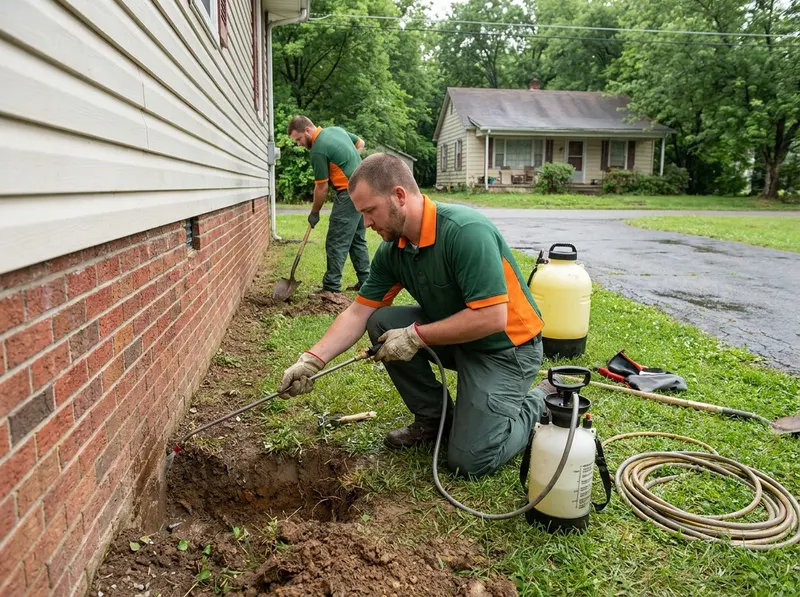
Technicians determine whether a comprehensive non-repellent perimeter trenching system, an exterior bait station array, or a localized spot treatment provides the appropriate structural protection. For full perimeter remediation, trenching requires digging 6 inches wide and 6 inches deep around the foundation perimeter, applying liquid termiticide at a standard rate of 4 gallons per 10 linear feet into the trench and backfill soil to establish an unbroken barrier. If a home in the West Side or Edgewood rests on a full crawl space with interior stone piers, each interior support pier requires perimeter treatment to neutralize hidden subterranean ground routes. Concrete porches or adjacent slab patios in Fort Hill and North Charleston require rod-drilling 0.5-inch holes spaced 12 inches apart to inject the termiticide directly into the gravel bedding below before patching the surface flush with concrete mortar.
The trade-off between exterior liquid barrier treatments and tamper-resistant bait stations centers on soil disruption versus colony eradication speed. A liquid barrier provides immediate subterranean exclusion around the structural envelope within hours of application, but requires ground excavation and drilling through exterior flatwork. An exterior baiting system requires no drilling through exterior porches and avoids disturbing established landscaping near the home, yet relies on subterranean workers foraging into bait stations over several weeks to ingest active growth-inhibiting matrices (such as noviflumuron). Standard remedial treatments do not require mandatory annual service contracts, though documented annual perimeter inspections remain the recognized standard for verifying barrier integrity against ground settlement or soil erosion.
Every job gets a firm, written price after a free on-site visit.
Tell us about your subterranean termite remediation job in Charleston and we'll send a clear, written quote, usually the same day.
 Tavirox Pest Management